


Imagine you're driving down the highway on an important trip and suddenly get a flat. If you have a spare tire, it's a minor inconvenience. If you don't, you're stranded. A redundant power supply (PSU) is that spare tire for your most important business hardware, making sure a single point of failure doesn't derail your entire operation.
The Foundation of Business Uptime
So, what is it, really? A redundant power supply is simply a second power unit built right into a single device like a server or a network switch. Its one and only job is to kick in the very instant the main power unit fails. There's no delay and no downtime.
This immediate failover is the key to maintaining uptime—a simple measure of how long your critical systems are up and running. For any business that depends on its technology, uptime isn't just a technical term; it's directly tied to revenue, client trust, and productivity. An hour of downtime can cost a business dearly.
Why Power Redundancy Matters
Think about the real-world impact. A law firm needs 24/7 access to its case files. A dental practice can't function without its patient records and billing systems. In these places, a server suddenly going dark because a small power component failed isn't just an IT problem—it's a full-blown business crisis. Redundancy turns that potential crisis into a non-event.
The business world has clearly caught on. The global market for redundant power supplies was valued at USD 8.5 billion in 2023 and is expected to climb to USD 15.3 billion by 2032. This isn't just a niche trend; it shows that reliable power is now a non-negotiable part of modern business. You can explore more about these market trends and what they mean for building resilient infrastructure.
It's telling that over 80% of new data centers are now built with redundant power systems from the start. This isn't seen as an optional extra anymore; it's the standard for any business that takes its operations seriously.
At the end of the day, investing in power redundancy is about putting a stable foundation under your business. It tackles one of the most common and disruptive hardware failures head-on, letting you worry about your clients instead of your IT. It’s the first, most critical step toward a truly reliable infrastructure.
How Different Redundancy Models Protect Your Systems
Knowing you need a backup power supply is the easy part. The harder part is figuring out which backup strategy is right for you, because not all redundancy plans are built the same. In the IT world, we use simple formulas like N+1 and N+N to describe these models, each offering a different level of protection for your critical gear.
It's pretty straightforward. 'N' is just the number of power supply units (PSUs) your system absolutely needs to run. The number that comes after the '+' tells you how many spares you have on standby.
Understanding N+1 Redundancy
The most common and budget-friendly approach is N+1 redundancy. Think of it as having one spare tire for your car—it can replace any one of the four that fails. If your server rack needs four PSUs to operate (N=4), an N+1 setup adds a fifth (+1) unit that sits idle, ready to jump in.
When one of the primary PSUs fails, that spare instantly takes over the load. This is a really efficient way to build in a safety net, since one extra unit protects the whole system. The catch? It's designed for a single failure. If a second PSU dies before you can replace the first one, your system will go down.
Hot-Swapping: The Zero-Downtime Repair
This is where modern redundant systems really shine. Hot-swapping means you can pull out a failed power supply and slide a new one in while the server is still running. The backup PSU keeps things humming along, turning a potential disaster into a minor maintenance task with absolutely no interruption to your work.
N+N: The Ultimate Protection
For organizations where even a second of downtime is too costly, there’s the N+N model. This is also called 2N or "full redundancy," and it's the gold standard for uptime. Instead of just adding a spare unit, you duplicate the entire power infrastructure. If your system needs four PSUs to run (N=4), an N+N configuration gives you a completely separate, parallel system with another four PSUs.
It’s like having two independent power grids feeding your building. If the first grid goes dark, the second one is already carrying the load, so nothing ever flickers. It’s definitely a bigger investment, but N+N offers the highest possible protection against multiple hardware failures or even entire circuit outages.
This diagram gives you a simple visual of how a backup power source keeps a server online if the primary one gives out.
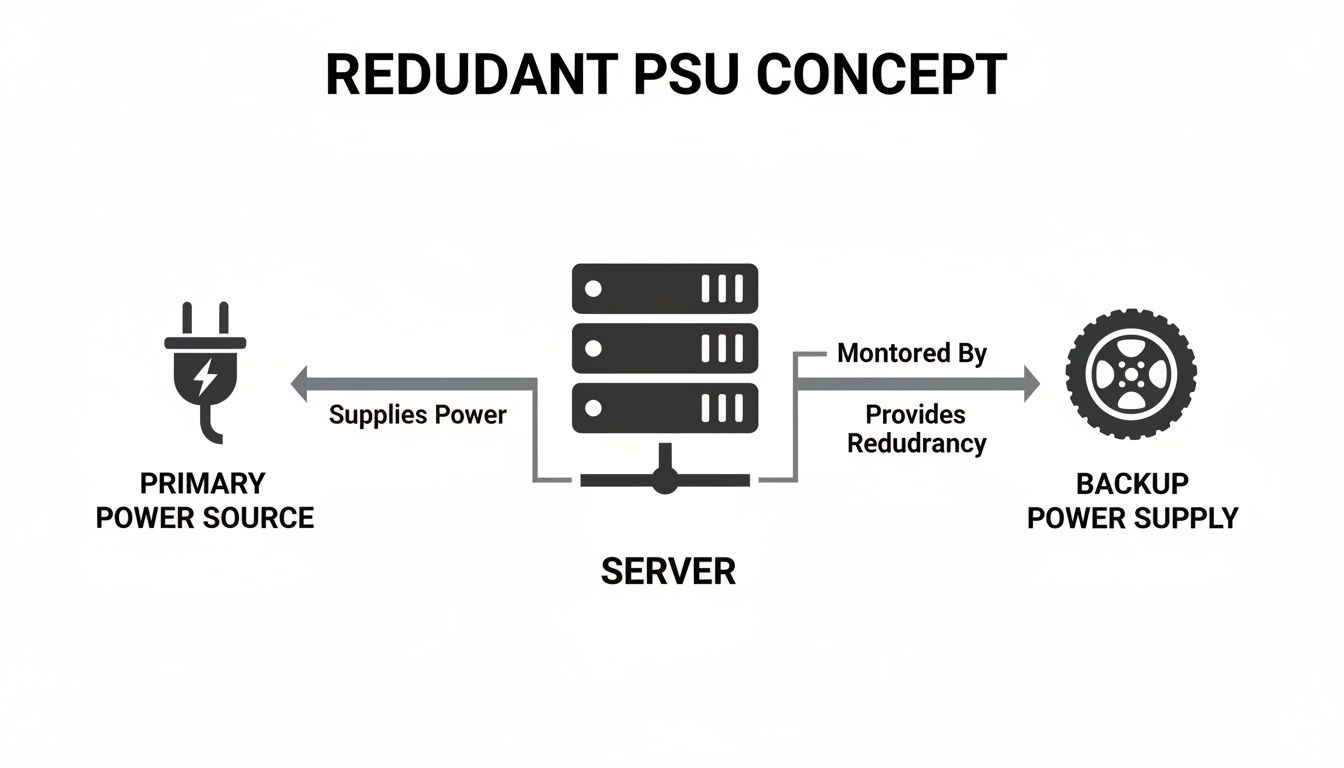
The core idea is creating an alternate path for electricity, so a single broken component can't take down the whole show. It's fascinating to see how the same principles of reliability and redundancy apply across different fields, from IT infrastructure to public safety systems.
Ultimately, choosing the right model comes down to your business's appetite for risk. N+1 is a huge leap forward from having no backup at all, while N+N delivers true peace of mind. Both are critical building blocks for a resilient business, and they work hand-in-glove with other high-availability solutions. To see how this concept extends beyond just power, you can read more about how failover clustering works to protect entire servers.
The Real Business Benefits of Power Redundancy
We've covered the technical side, but let's get down to what really matters: what does a redundant power supply actually do for your business? The short answer is that it's a direct line to stability, growth, and frankly, peace of mind. It’s an investment that protects your operations from stopping dead in their tracks.
The most obvious win is maximized uptime. Downtime isn't just a minor hiccup; it's lost sales, blown deadlines, and clients who are losing patience. When a primary power unit fails—and they do—a redundant PSU instantly picks up the slack. It ensures a very common hardware failure doesn't bring your entire business to its knees.
From a Technical Feature to a Business Asset
This kind of reliability creates a positive ripple effect you can see and feel across the company. Just picture these real-world situations:
- Protecting Critical Transactions: Imagine a financial advisor executing a time-sensitive trade when the server suddenly dies. With power redundancy, that server stays online, the trade completes, and a potential disaster is completely avoided.
- Meeting Every Deadline: A law firm is up against a court deadline, and its document management system goes dark. A redundant power supply keeps those crucial case files accessible, ensuring the firm meets its obligations and protects its professional reputation.
- Ensuring Seamless Client Service: For a busy dental practice, the appointment and billing software is the heart of the operation. Power redundancy prevents a simple PSU failure from canceling appointments and throwing the whole day into chaos.
In every one of these examples, the technology itself isn't the main point—the uninterrupted flow of business is. This is where you have to think about your own disaster recovery goals. You can learn more about defining your Recovery Time Objective (RTO) and Recovery Point Objective (RPO) to figure out how uptime factors into your broader continuity plan.
The market has certainly taken notice. What was once a "nice-to-have" is now standard practice. The global demand for redundant power systems is growing at a steady 13.10% each year. Here in North America, the market was valued at USD 900 million in 2024 and is forecast to reach USD 1,600 million by 2035. This isn't just a fad; it’s a serious commitment to building resilient infrastructure. You can discover more insights about the growing PSU market and see the trend for yourself.
Redundancy also makes maintenance far less stressful and can even help your expensive equipment last longer. With a hot-swappable backup ready to go, you can replace a failing power supply during normal business hours without disrupting anyone's work.
This proactive approach stops a single, overworked power supply from shouldering the entire load, which often leads to overheating and can cause other components to fail prematurely. It turns a potential weekend emergency into a routine, manageable task. When you look at the big picture, investing in power redundancy is one of the smartest moves you can make for the long-term health of your business.
Where Your Business Needs Redundancy Most
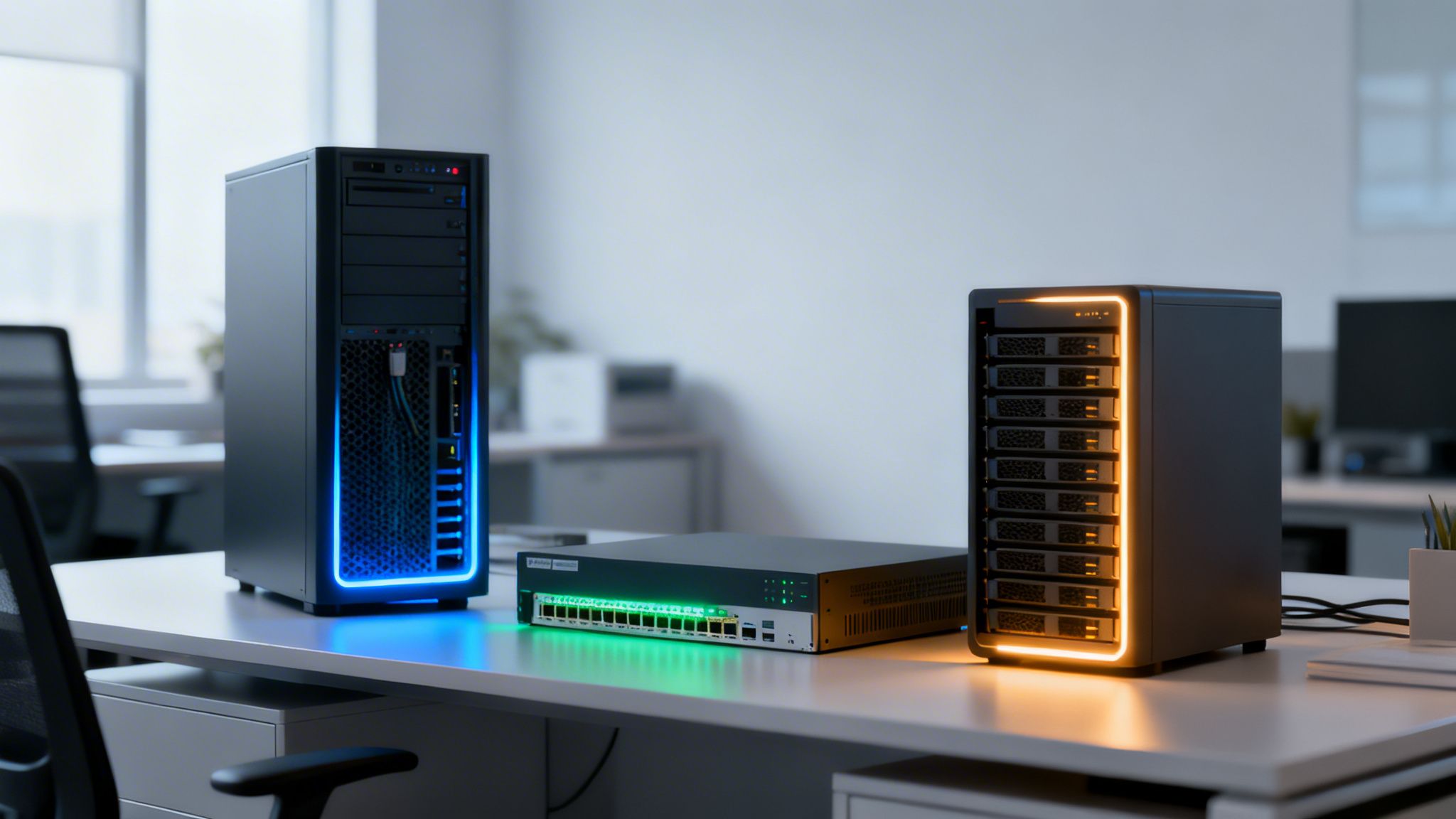
So, you understand the theory behind redundant power supplies. The real question is, where should you actually put them to get the most bang for your buck? This isn't just a strategy for huge data centers; it's a practical move for the everyday equipment that keeps your business running.
Certain devices are so essential to your daily operations that if one goes down, it triggers an immediate, company-wide crisis. For most small and mid-sized businesses, the list of mission-critical hardware is surprisingly short. These are the pillars of your IT infrastructure, and protecting them isn't just a good idea—it's essential for guaranteeing uptime.
Focus on These Critical Components
If you're not sure where to start, think about which pieces of hardware would cause the most chaos if they suddenly blinked out of existence. For almost every business we work with, the answer comes down to three key areas.
- Servers: A server is the brain of your entire operation. It's running your core applications, holding your databases, and handling user logins. When a server's power supply dies, everything stops. No one can access the data or the tools they need to do their jobs.
- Network Switches: If the server is the brain, your network switches are the central nervous system. They're the unsung heroes connecting all your computers, printers, and phones to each other and the outside world. A failed switch is an instant communication blackout—no email, no shared files, and often, no phone service.
- Storage Systems (NAS/SAN): Your data is arguably your most valuable asset, and it almost certainly lives on a dedicated storage device like a Network Attached Storage (NAS) or a Storage Area Network (SAN). A power failure here is terrifying because you’re not just looking at downtime; you're facing the very real risk of data corruption or permanent loss.
A single PSU failure in any of these devices can be devastating. An outage lasting just one hour can lead to lost revenue, wasted payroll, and a hit to your professional reputation. In fact, a Gartner study once estimated the average cost of IT downtime at $5,600 per minute. While your number might be different, the pain is always real and significant.
The question isn't if a power supply will fail, but when. These components run 24/7 under constant stress and are guaranteed to wear out eventually. Proactively building in redundancy transforms a potential disaster into a minor, non-disruptive maintenance event.
By identifying these critical choke points, you can make a smart, strategic investment in redundant power supplies right where they'll protect you most. It’s the single best way to make sure the heart of your business keeps beating, no matter what surprises come your way.
Building a Complete Power Protection Strategy
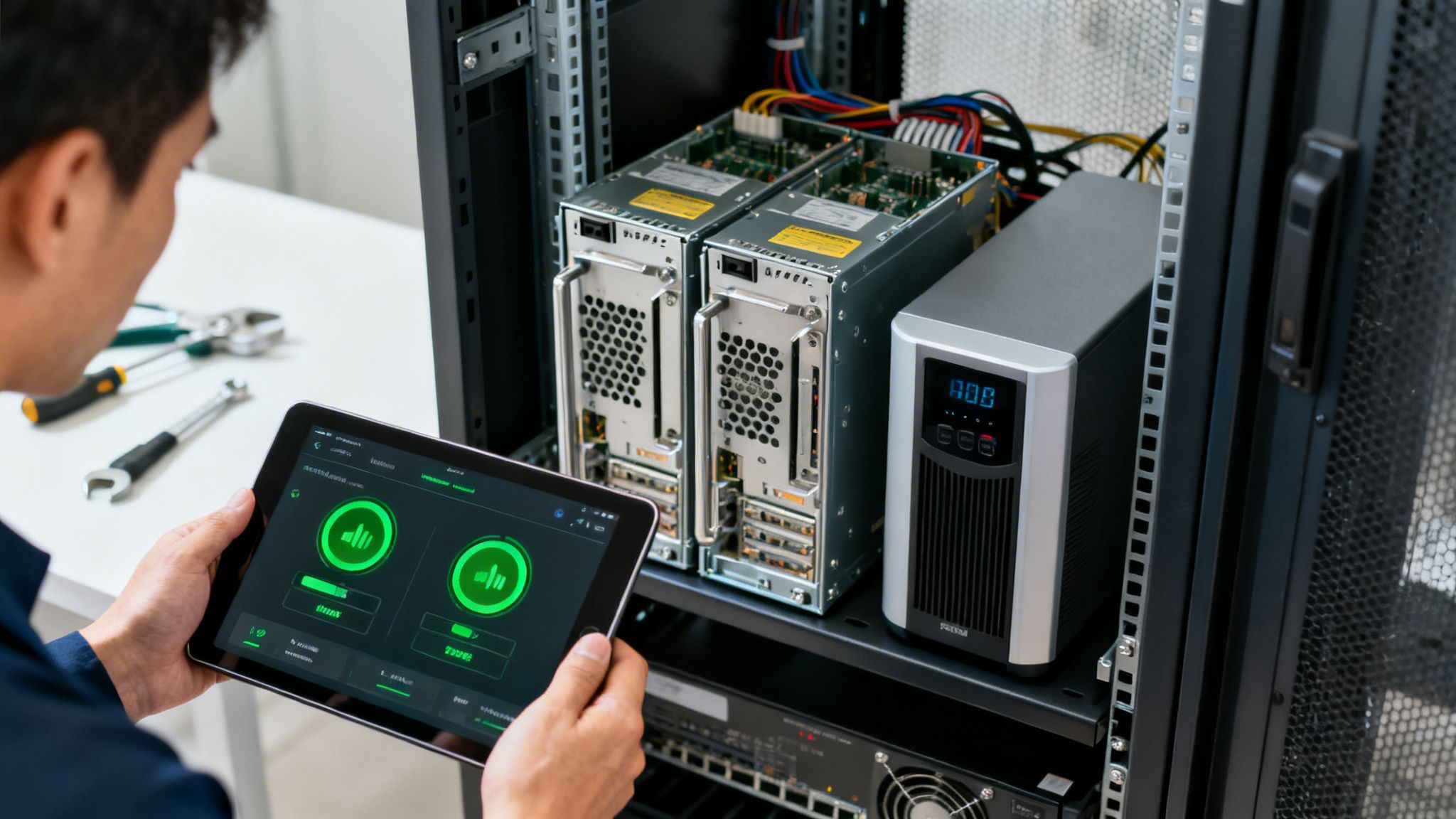
A redundant power supply is a powerful shield against internal hardware failure, but it can’t protect your business from everything. To be truly prepared, you have to look beyond just the server itself and build a strategy that defends against threats coming from outside your office walls, too.
This is where many business owners get tripped up, often confusing a redundant PSU with an Uninterruptible Power Supply (UPS). While they both deal with power, they solve very different problems. Getting this distinction right is crucial.
Redundant PSU vs. Uninterruptible Power Supply (UPS)
It’s easy to get these two mixed up, but a simple analogy clears things up. A redundant PSU is like having a spare engine in your car; if the primary one dies, the backup kicks in immediately. It protects the car from an internal failure.
A UPS, however, is like having an extra tank of fuel. It has nothing to do with the engine itself—it protects you from an external issue, like the gas station being closed or running out of fuel.
The same principle applies to your tech. A redundant PSU keeps your server running if one of its own power supply units fails. A UPS keeps that same server running if the power grid goes down or a surge comes through the lines.
To make this perfectly clear, here's how they stack up:
Redundant PSU vs Uninterruptible Power Supply (UPS)
| Feature | Redundant Power Supply (PSU) | Uninterruptible Power Supply (UPS) |
|---|---|---|
| Primary Role | Provides backup power inside a single device. | Provides temporary battery power to multiple devices. |
| Protects Against | Internal PSU component failure. | External power outages, surges, and brownouts. |
| How It Works | A second PSU instantly takes over when the first one fails. | A battery backup kicks in when grid power is lost. |
| Scope | Device-level (e.g., one server, one switch). | System-level (e.g., an entire server rack). |
You don't choose one or the other; for real protection, you need both. The UPS gives your server a lifeline during a blackout, and the redundant PSU makes sure the server itself doesn't die from a component failure during that critical moment.
The Role of Proactive Monitoring
Here’s a scenario we see all the time: a primary PSU fails, and the redundant unit seamlessly takes over. Everything appears fine. But without proper monitoring, no one knows the system is now running without a backup. When that second PSU eventually fails—and it will—you get a sudden, catastrophic outage.
This is why hardware alone isn't enough. With proactive monitoring from a managed IT partner like GT Computing, an alert is triggered the instant that first PSU goes down. This lets our team schedule a quick hot-swap replacement, turning a potential disaster into a simple maintenance ticket. It’s about ensuring your "spare tire" is always ready for action.
A well-designed power strategy also often includes technologies like Automatic Transfer Switch (ATS) systems, which are key to ensuring a smooth transition between power sources without any downtime. All these elements are foundational to a solid small business disaster recovery plan that protects you from every angle.
How to Know When Your Business Needs Redundancy
So, does your business actually need a redundant power supply? The answer has less to do with technical jargon and more to do with your stomach for risk. It really boils down to a few honest questions about your day-to-day operations and what happens when the unexpected strikes.
Let's get straight to the point: what would happen if your main server went down for an hour? Or for a whole afternoon? If the answer is a casual "not much," then you can probably hold off. But if that thought makes you break into a cold sweat thinking about lost sales, angry clients, or a staff that can't work, then you're running your business on a single point of failure. That's a huge gamble.
A Simple Risk Assessment
Think through these real-world scenarios. If you find yourself nodding "yes" to any of them, it’s a strong sign that you should be seriously considering power redundancy.
- Do you rely on one central server? When a single machine hosts your essential applications, files, or customer database, its failure means your entire business grinds to a halt.
- Is your data irreplaceable? For professionals in law, medicine, or finance, even temporary loss of access to sensitive client data can shatter your reputation and break trust that took years to build.
- Would downtime cost you money? Do the math on what an outage truly costs. You have to factor in more than just lost sales—think about paying employees who can't do their jobs and the long-term cost of clients who leave for a more reliable competitor.
Investing in a redundant power supply isn't an expense—it's business insurance. It’s a proactive measure that shields your revenue, productivity, and professional standing from a very common and disruptive hardware failure.
This forward-thinking approach is quickly becoming standard practice. Just look at the AI server industry, which is now a huge driver in the redundant power supply market. For businesses like law firms and dental practices looking to upgrade their systems, this trend signals a critical shift. Redundant power is no longer a "nice-to-have" luxury; it's essential infrastructure for avoiding expensive disasters. You can learn more about how new technologies are driving this demand.
If the idea of an unexpected server crash keeps you up at night, it's time to stop worrying and start acting. A redundant power supply turns that potential crisis into a complete non-event, letting you get back to running your business.
Your Next Step Towards a Resilient Business
We've covered a lot of ground, from what a redundant power supply is to how it keeps your business humming along without interruption. The real takeaway is simple: being proactive about power always, always costs less than cleaning up after a failure.
Think of it as the foundation of your entire IT operation. A redundant power supply isn't just a piece of hardware; it’s your first line of defense, protecting your operations, your data, and ultimately, your reputation. It’s one of the smartest, most straightforward investments you can make for the long-term health of your company.
True business resilience isn't about bracing for disaster. It's about building an IT infrastructure so reliable that potential emergencies become minor, manageable events you barely even notice.
When your power strategy is solid, your team can work without interruption, your customers stay satisfied, and your critical information remains safe. You get to run your business without constantly looking over your shoulder for the next IT crisis. The last thing you want is for a simple power outage to expose a critical flaw in your setup.
Keep your business running without IT headaches.
GT Computing provides fast, reliable support for both residential and business clients. Whether you need network setup, data recovery, or managed IT services, we help you stay secure and productive.
Contact us today for a free consultation.
Call 203-804-3053 or email Dave@gtcomputing.com