


In today's fast-paced business environment, your communication system is the backbone of your operations. Traditional phone lines, with their high costs, physical limitations, and lack of modern features, are no longer sufficient to keep you competitive. Migrating to a Voice over Internet Protocol (VoIP) system isn't just an upgrade; it's a strategic business decision that unlocks significant cost savings, unparalleled flexibility, and powerful features that drive productivity and professionalism. From supporting remote workforces to integrating seamlessly with your essential business tools, the benefits of VoIP for business are substantial.
This is particularly true for professional services like law firms and dental practices, where client communication, reliability, and compliance are paramount. But what specific advantages can you expect, and how do they translate into a tangible return on investment? In this guide, we'll explore the nine most impactful benefits of adopting a VoIP system. We will provide actionable insights, real-world examples, and expert tips to help you make the switch with confidence. Discover how a modern phone system, expertly managed, can become one of your greatest business assets.
1. Significant Cost Reduction and ROI
One of the most immediate and compelling benefits of VoIP for business is the direct impact on your bottom line. By transmitting calls over your existing internet connection instead of traditional copper phone lines, VoIP systems eliminate the need for costly infrastructure maintained by legacy telephone companies. This fundamental shift often results in monthly phone bill reductions of 40-60%.

The savings extend beyond the monthly bill. Traditional PBX systems involve expensive hardware, separate maintenance contracts, and high per-minute charges for long-distance and international calls. VoIP consolidates these into a predictable, per-user monthly fee, making costs transparent and scalable.
Real-World Savings Scenarios
- Law Firms: A multi-office law practice can unify communications under one system, eliminating redundant lines and reducing its phone expenses by over 50% while connecting attorneys and paralegals across different locations seamlessly.
- Dental Practices: A growing dental office can consolidate its multiple phone lines used for appointments, billing, and patient inquiries into a single, efficient VoIP system, saving hundreds per month.
- Connecticut SMBs: Mid-sized businesses in Connecticut switching from traditional PBX systems have reported annual savings of over $300 per employee, reallocating those funds to growth initiatives.
Actionable Tips for Implementation
Before making the switch, a clear financial picture is essential. Conduct a thorough audit of your current phone usage to identify where the biggest savings will come from. When evaluating providers, focus on transparent, per-seat pricing models like those from RingCentral or 8×8. Finally, calculate the total cost of ownership, factoring in any necessary internet bandwidth upgrades to ensure call quality and reliability. Choosing a provider that lets you select specific features rather than paying for a bloated bundle ensures you only pay for what you actually need.
2. Enhanced Mobility and Remote Work Capability
One of the most practical benefits of VoIP for business is its ability to free your communications from the confines of a physical office. Since calls are managed over the internet, employees can make and receive calls on their professional business numbers from anywhere with a stable connection. This empowers them to use smartphones, tablets, or computers as fully functional office extensions, whether at home, a client site, or a coffee shop.

This level of flexibility is essential for maintaining productivity and a professional image in today's workforce. Employees can access their complete business phone system, including voicemail, call logs, and advanced forwarding features, regardless of their location. This untethered access ensures business continuity and responsiveness, directly supporting remote and hybrid work models.
Real-World Mobility Scenarios
- Law Firms: Attorneys can securely take and make client calls using their official office number on a mobile app while traveling between court and their office, ensuring client confidentiality and professional presence.
- Dental Practices: A practice with multiple locations can operate under a single, unified phone system. Staff can answer calls for any office from any location, improving patient service and operational efficiency.
- Connecticut SMBs: Businesses across Connecticut can maintain full operational continuity during severe weather events or other office closures, as employees can seamlessly switch to working from home without any disruption to client communications.
Actionable Tips for Implementation
To properly support a mobile workforce, start by implementing strong security policies for any device accessing the network remotely. It's critical to test and confirm that remote work locations have adequate internet bandwidth to maintain high call quality. Before a full rollout, provide thorough training on the mobile app's features, like presence indicators that show a colleague's availability. Setting up automatic call forwarding rules based on time or an employee's status can further automate and improve communication workflows.
3. Scalability Without Infrastructure Investment
A key benefit of VoIP for business is its ability to grow or shrink in lockstep with your operational needs. Traditional phone systems tether growth to expensive and time-consuming infrastructure projects. With VoIP, scaling is a matter of software provisioning, not hardware installation, allowing your communication system to remain flexible and cost-effective as your company evolves.
Adding a new employee no longer requires a technician to run new physical phone lines or install a dedicated port on a PBX box. Instead, an administrator can simply add a new user to the system via a web portal. This user is instantly live and can make calls from a desk phone, computer softphone, or mobile app. This agility is invaluable for businesses with seasonal fluctuations or rapid growth phases.
Real-World Scaling Scenarios
- Dental Practices: A dental group expanding from a single office to five locations can deploy a unified phone system where calls can be routed to any office, all managed from one central dashboard without any new on-site hardware.
- Law Firms: As a firm hires a new paralegal department, it can instantly provision ten new phone extensions and voicemail boxes in minutes, avoiding the weeks-long delay and high cost associated with traditional telecom providers.
- Hamden Mid-Sized Businesses: A growing business in Hamden can manage its expansion without the massive capital expenditure of replacing its aging PBX system, instead opting for a flexible, per-user VoIP model that scales on demand.
Actionable Tips for Implementation
To ensure smooth growth, plan for proportional increases in internet bandwidth as you add users. It’s wise to monitor system performance and call quality metrics closely during periods of rapid scaling. Look for providers that offer metered or flexible pricing so your costs directly align with your actual usage. Finally, implementing role-based user profiles from the start makes provisioning new hires more efficient and secure.
4. Advanced Call Management and Professional Features
Another significant benefit of VoIP for business is access to enterprise-grade call management features that were once prohibitively expensive. Modern VoIP systems equip small and mid-sized businesses with tools to project a polished, professional image and manage communications with exceptional efficiency. Features like auto-attendants, intelligent call routing, and call queuing prevent missed calls and ensure clients always reach the right person or department, elevating the customer experience.

Beyond basic call routing, many VoIP systems offer sophisticated features like call recording and the ability to automatically and efficiently transcribe meeting audio to text, transforming spoken words into searchable, actionable data. This capability is crucial for professional services where quality assurance, compliance, and detailed record-keeping directly impact business reputation.
Real-World Scenarios for Professional Services
- Law Offices: A law firm can use call recording for client interaction documentation and training purposes, ensuring compliance and maintaining a high standard of service. Intelligent routing can direct new client inquiries to an intake specialist while sending existing client calls directly to the assigned attorney's extension.
- Dental Practices: A multi-practitioner dental office can implement an auto-attendant to offer callers options for scheduling, billing, or emergencies. This frees up front desk staff to focus on in-person patients while ensuring every call is handled appropriately.
- Multi-Office Businesses: A company with specialists in different locations can use presence indicators and find me/follow me routing to ensure important calls reach the right expert, whether they are in the office, working from home, or traveling.
Actionable Tips for Implementation
To maximize these features, configure your auto-attendant with clear, concise menu options that don't overwhelm the caller. When using call recording, always implement proper legal disclaimers to ensure compliance with Connecticut’s two-party consent laws. It’s also wise to set up distinct call routing rules for business hours and after-hours to manage expectations. Regularly review call analytics to identify bottlenecks and train your staff on best practices for managing voicemails and using conference features for client meetings. Finding the right tools for your specific needs is simple when you know what to look for in the best office phone systems available today.
5. Integration with Business Applications and CRM
A standalone phone system is a relic of the past. One of the most powerful benefits of VoIP for business is its ability to integrate with the software you already use, like customer relationship management (CRM) platforms, email, and other productivity tools. This creates a single, unified communications hub where data flows automatically between systems, turning your phone into an intelligent business tool.
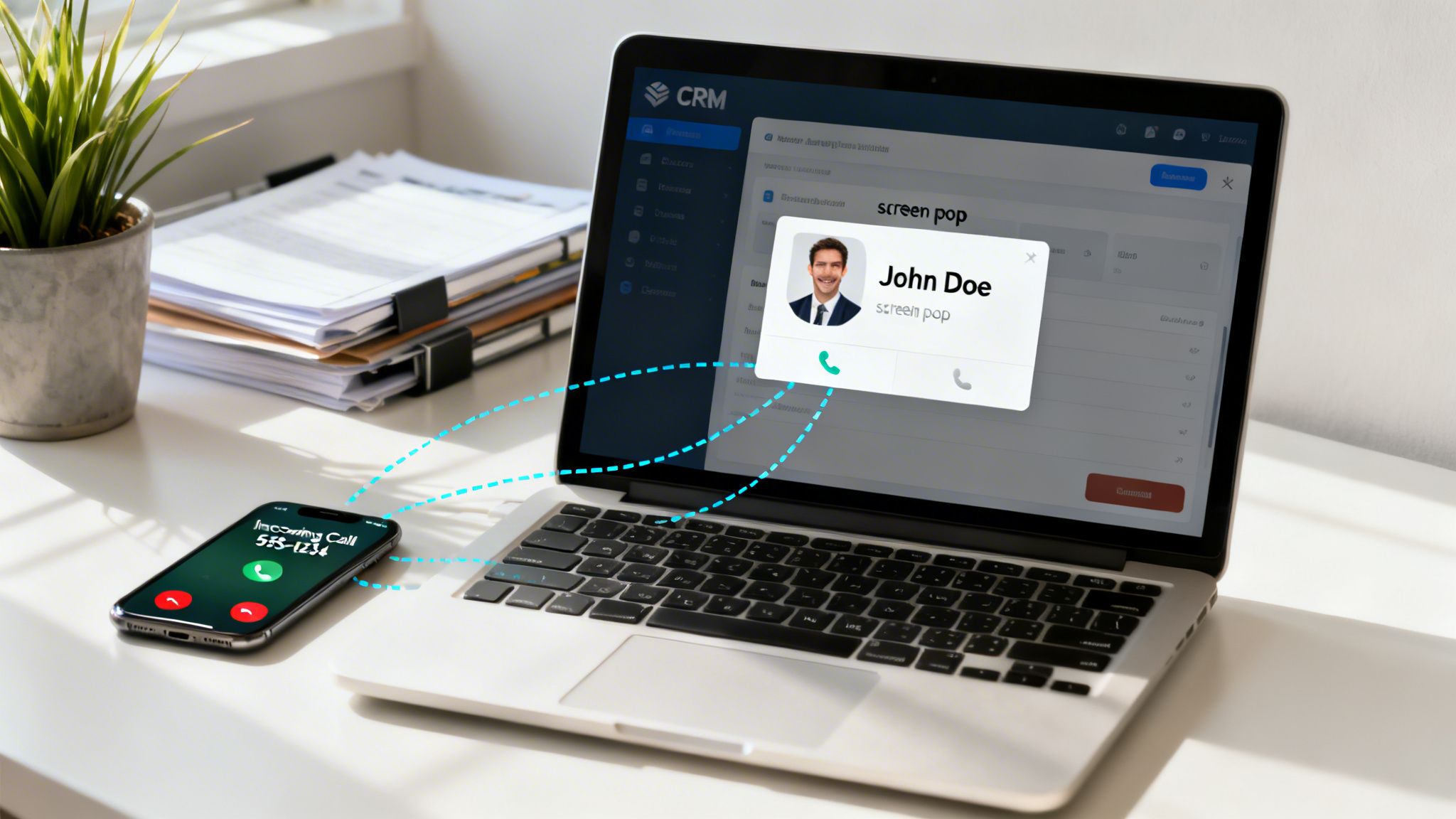
When your systems are connected, client information appears on-screen the moment they call, call logs are automatically saved to their contact record, and meetings can be scheduled directly from a call. This automation eliminates manual data entry, reduces human error, and provides your team with crucial context for every conversation.
Real-World Integration Scenarios
- Law Practices: A law firm can integrate its VoIP system with case management software like Clio or PracticePanther. When a client calls, their entire case history, notes, and billing status can appear automatically, allowing staff to provide informed, immediate service.
- Dental Offices: Syncing a VoIP phone with patient management software like Dentrix means that when a patient calls, receptionists instantly see their appointment history, upcoming visits, and outstanding balance, streamlining the scheduling process.
- Connecticut Professional Services: A local consulting firm can use API integrations to connect its phone system to project management tools, automatically logging billable hours for client calls and ensuring every minute is accounted for.
Actionable Tips for Implementation
Before choosing a VoIP provider, audit your current business applications to identify mission-critical systems that need integration. Prioritize providers like RingCentral or Microsoft Teams that offer pre-built connections to your software. It is critical to plan the integration phase during implementation, not as an afterthought, to ensure a smooth transition. Finally, remember to train your staff on the new, integrated workflows so they can take full advantage of the efficiency gains. For complex setups, hiring an expert like GT Computing can ensure the integration is secure, compliant, and correctly configured.
6. Improved Business continuity and Disaster Recovery
One of the most critical benefits of VoIP for business is its inherent resilience. Since calls are routed over the internet instead of through physical phone lines tied to your office, your communication system can remain active even if your building is inaccessible. This ability to maintain operations during power outages, natural disasters, or other emergencies is a cornerstone of modern business continuity. Calls can be automatically forwarded to alternate locations, mobile phones, or home offices, ensuring you never miss a client's call.
Unlike traditional phone systems that fail when the lines are down, a VoIP setup allows your business to function from anywhere with an internet connection. Popular solutions from providers like Cisco, 8×8, and Microsoft Teams have built-in disaster recovery features that make this failover process seamless, protecting your revenue and client relationships when disaster strikes.
Real-World Resilience Scenarios
- Connecticut Law Firms: During the COVID-19 lockdowns, law practices using VoIP maintained uninterrupted client communication by instantly routing office calls to attorneys working from home, ensuring case continuity.
- Dental Practices: A practice undergoing extensive office renovations can continue booking appointments and handling patient inquiries by having all calls forwarded to a temporary administrative location or a manager's mobile device.
- Multi-Location Businesses: If one branch office closes due to a localized power outage, a unified VoIP system automatically reroutes its calls to another open branch, so clients experience no disruption in service.
Actionable Tips for Implementation
A proactive approach is key to guaranteeing uptime. Start by implementing redundant internet connections, such as a primary fiber line backed up by a secondary broadband or 4G/5G connection. Configure automatic call-forwarding rules that trigger if your primary office system goes offline. It is vital to create a small business disaster recovery plan that documents these procedures and test them quarterly to ensure they work as expected. Finally, partner with an expert like GT Computing to design a robust failover strategy and select a provider with a strong uptime Service Level Agreement (SLA) of 99.99% or higher.
7. Superior Call Quality and Reliability
A common misconception about VoIP is that internet-based calls are inherently less clear than traditional phone lines. Modern VoIP systems, however, deliver call quality that often surpasses legacy analog systems. This is achieved through technologies like HD Voice, advanced noise cancellation, and intelligent bandwidth management, ensuring conversations are crystal clear and free of static or jitter.
Professional VoIP providers engineer their networks for carrier-grade reliability, often backed by service level agreements (SLAs) guaranteeing 99.9% uptime or higher. By using advanced codecs like G.722 and prioritizing voice data with Quality of Service (QoS) settings, these systems maintain clear, uninterrupted audio even during periods of high network traffic. This level of dependability is a key benefit of VoIP for business, especially in professional settings where every word matters.
Real-World Clarity Scenarios
- Law Firms: Attorneys conducting remote depositions can rely on courtroom-quality audio, ensuring every testimony is captured with perfect clarity and no interruptions, which is critical for the legal record.
- Dental Practices: A practice manager can hold a clear consultation call with a specialist or discuss sensitive patient information without worrying about dropped calls or garbled audio, maintaining professionalism and patient trust.
- Connecticut SMBs: Businesses across Connecticut transitioning to VoIP find that their call quality is indistinguishable from, or better than, their old, expensive PBX systems, all while gaining modern features.
Actionable Tips for Implementation
To guarantee the best performance, your network must be prepared for VoIP traffic. Start with a thorough network assessment to identify potential bottlenecks. Configure QoS settings on your router to prioritize voice packets over other data, preventing lag or dropped calls. Before a full rollout, test call quality on all proposed devices, from desk phones to softphone apps, to confirm compatibility. For ultimate clarity, select HD Voice-compatible phones and headsets from trusted brands like Polycom or Plantronics. Working with an expert like GT Computing can help optimize your network specifically for VoIP quality.
8. Regulatory Compliance and Enhanced Security
Beyond cost savings and features, one of the most critical benefits of VoIP for business, especially in regulated industries, is its ability to support stringent security and compliance mandates. Enterprise-grade VoIP systems are built with features like encrypted communications, detailed audit logs, and secure call recording storage. This is essential for protecting sensitive information and meeting regulatory obligations.
This level of security is made possible through standards like AES encryption for voice traffic and provider certifications such as SOC 2 and ISO 27001. For professional services handling confidential data, these security layers are not just beneficial; they are a core requirement for operation. VoIP providers like Vonage and RingCentral have developed specific feature sets to address these needs directly.
Real-World Compliance Scenarios
- Law Firms: Attorneys can use encrypted VoIP communications to protect attorney-client privilege. Call logs and recordings provide a verifiable chain of custody for discovery requests, meeting strict legal and ethical standards.
- Dental Practices: A practice handling patient information over the phone can use a HIPAA-compliant VoIP system to protect sensitive health data, avoiding significant fines and maintaining patient trust.
- Connecticut Professional Services: A Connecticut-based financial advisory firm can pass regulatory audits with flying colors by presenting comprehensive VoIP system logs that demonstrate adherence to state and federal data handling requirements.
Actionable Tips for Implementation
To ensure your system meets compliance standards, start by choosing a provider with explicit certifications for your industry, such as HIPAA or SOC 2. When implementing call recording, always use proper legal disclaimers to inform all parties. Set up role-based access controls to limit who can listen to or delete sensitive recordings. Partnering with an IT expert like GT Computing ensures your system is configured correctly for security and that ongoing monitoring is in place. Finally, conduct quarterly audits of your VoIP system and maintain clear documentation of your compliance measures.
9. Reduced IT Maintenance Burden and Total Cost of Ownership
Another one of the core benefits of VoIP for business is the significant offloading of IT responsibilities. Cloud-based VoIP moves the complex hardware and software from your office to the provider's secure data centers. This shift means your provider handles all system updates, security patches, and infrastructure maintenance automatically, freeing your internal IT team from the constant burden of telephony support.
This reduction in hands-on management directly lowers the total cost of ownership (TCO). Instead of budgeting for hardware replacements, emergency repairs, and the specialized staff needed to administer a traditional PBX, your costs are consolidated into a predictable subscription. This allows IT staff to focus on strategic initiatives that drive business growth, rather than fixing phone problems.
Real-World IT Simplification
- Small Law Firms: A boutique firm can eliminate the need for a dedicated phone system administrator or costly third-party vendor, as the cloud provider handles all backend management.
- Dental Practices: With a managed VoIP service, a practice reduces its IT complexity, ensuring the front desk’s critical communication lines are always operational without needing an on-site technician for support.
- Multi-Location Organizations: A business with several branches can manage its entire phone system through a single web portal, eliminating the need for separate IT support at each location.
Actionable Tips for Implementation
To fully grasp the financial impact, calculate the true TCO of your current system, including staff time spent on maintenance and administration. When evaluating new providers like RingCentral or Microsoft Teams Phone, prioritize those with comprehensive self-service portals to empower your team. It's also wise to formalize your IT strategy by working with an expert; professional managed IT services for small businesses can help you optimize your network for VoIP and redirect freed-up resources toward critical areas like cybersecurity and data protection. Ensure you request clear Service Level Agreements (SLAs) from any potential VoIP provider to guarantee support response times.
VoIP for Business: 9-Point Benefits Comparison
| Feature | 🔄 Implementation complexity | ⚡ Resource requirements | 📊 Expected outcomes | 💡 Ideal use cases | ⭐ Key advantages |
|---|---|---|---|---|---|
| Significant Cost Reduction and ROI | Medium — migration and possible network upgrades | Broadband required; per-user subscriptions; minimal hardware | 40–60% lower monthly bills; ROI typically 6–12 months | SMBs (law/dental), multi-office consolidation, long‑distance reduction | ⭐ Substantial OPEX savings; predictable per-seat billing; no PBX CapEx |
| Enhanced Mobility and Remote Work Capability | Low–Medium — app rollout, security policies, user training | Reliable internet on devices; mobile apps; BYOD management | Consistent business presence anywhere; improved accessibility and productivity | Remote/hybrid teams; client-facing professionals; field staff | ⭐ Unified number across devices; flexible work; better client access |
| Scalability Without Infrastructure Investment | Low — cloud provisioning and license management | Ongoing per-user subscriptions; bandwidth planning | Instant user provisioning; no hardware installs; faster expansion | Growing practices, seasonal staffing, multi-location rollouts | ⭐ Elastic capacity; minimal deployment time; predictable scaling costs |
| Advanced Call Management and Professional Features | Medium–High — IVR/recording config and staff training | Feature-enabled plans; storage for recordings; admin time | Fewer missed calls; improved client experience; compliance support | Call-heavy firms, regulated practices, appointment-based services | ⭐ IVR, queuing, recording, transcription, and analytics for quality |
| Integration with Business Applications and CRM | Medium–High — API/configuration and data mapping | Technical expertise; CRM licenses; ongoing maintenance | Screen pops, automated call logs, streamlined workflows and follow-up | Firms using CRM/case management; sales/service workflows | ⭐ Contextual caller info; reduced data entry; workflow automation |
| Improved Business Continuity and Disaster Recovery | Medium — failover planning, testing, and configuration | Redundant internet, failover rules, mobile fallback, SLAs | Continuous communication during outages; faster recovery; reduced downtime | Critical service providers; multi-site firms in disruptive regions | ⭐ Geographic redundancy; automatic failover; maintained client access |
| Superior Call Quality and Reliability | Medium — QoS setup and device compatibility checks | Sufficient bandwidth; HD-capable phones/headsets; QoS-capable network gear | HD voice, low latency, carrier-grade uptime (e.g., 99.9%) | High-stakes consultations; transcription-dependent interactions | ⭐ Clear audio, noise suppression, consistent reliability |
| Regulatory Compliance and Enhanced Security | High — compliance configuration, audits, policy enforcement | Secure provider certifications, encryption, training; higher costs possible | HIPAA/attorney-client compliance; audit-ready logs; lower breach risk | Healthcare, legal, financial services handling sensitive data | ⭐ Encrypted calls/storage, audit trails, MFA and access controls |
| Reduced IT Maintenance Burden and Total Cost of Ownership | Low — migration then provider-handled maintenance | Subscription costs; minimal on-prem hardware; provider SLAs | Lower IT overhead; predictable OPEX; IT focus shifts to strategy | SMBs without telephony staff; firms reallocating IT resources | ⭐ Eliminates PBX admin, automatic updates, lower 5+ year TCO |
Ready to Make the Switch? Let GT Computing Handle the Details
The journey through the advantages of modern communication technology has shown that the benefits of VoIP for business are not just incremental improvements; they represent a fundamental shift in how companies operate, connect, and grow. We've explored how transitioning from traditional phone lines to a Voice over IP system can yield significant cost reductions, freeing up capital that can be reinvested into other critical areas of your business, from marketing to talent acquisition.
More than just a cost-saving measure, VoIP is the backbone of the modern, flexible workplace. It empowers your team with unparalleled mobility, allowing them to stay connected and productive whether they are in the office, at home, or meeting clients on the road. For practices like law firms or dental offices, this means a lawyer can take an important client call from the courthouse, or a dental office manager can handle appointment scheduling from a different location, ensuring no opportunity is missed.
Key Takeaways: From Theory to Action
The power of a VoIP system lies in its ability to adapt to your specific business needs. The key takeaways from our discussion are:
- Financial Advantage: Moving to VoIP directly impacts your bottom line by reducing monthly phone bills and eliminating the need for expensive hardware maintenance. The return on investment is often realized within months, not years.
- Operational Agility: Scalability is no longer a logistical nightmare. You can add or remove phone lines with a few clicks, ensuring your communication system grows in lockstep with your business without costly infrastructure overhauls.
- Professional Image: Advanced features like auto-attendants, call routing, and CRM integrations present a polished, professional image to your clients, rivaling the capabilities of large enterprises. This is particularly valuable for small and mid-sized businesses looking to build credibility and trust.
- Resilience and Security: With built-in business continuity and robust security protocols, VoIP protects your most critical communication lines from local outages, disasters, and cyber threats, ensuring compliance and peace of mind.
Ultimately, the most crucial benefit of VoIP for business is its role as a strategic asset. It’s not just a phone system; it’s a platform for better customer service, more efficient internal collaboration, and sustainable growth. Making the switch is a clear strategic decision that positions your organization for future success by creating a more resilient, flexible, and cost-effective operational framework. The question is no longer if you should switch, but how you can make the transition as smoothly and effectively as possible.
Ready to unlock these benefits without the technical headaches? GT Computing specializes in designing and implementing custom VoIP solutions for businesses just like yours. We handle the entire process, from network assessment to final installation and ongoing support, ensuring you get a system that works perfectly for your unique needs.
Keep your business running without IT headaches.
GT Computing provides fast, reliable support for both residential and business clients. Whether you need network setup, data recovery, or managed IT services, we help you stay secure and productive.
Contact us today for a free consultation.
Call 203-804-3053 or email Dave@gtcomputing.com