


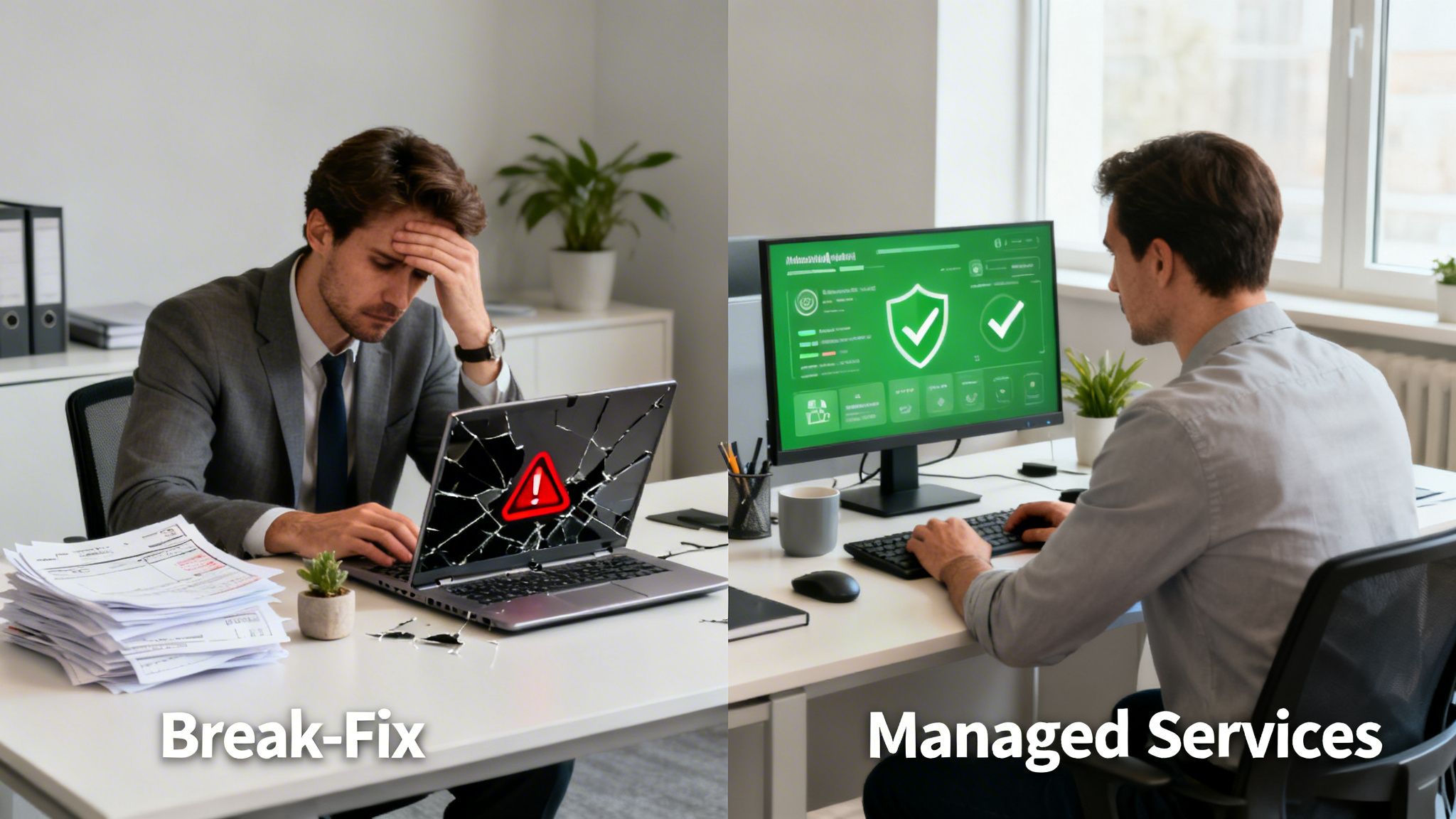
When you're looking at managed services vs break fix, the difference really boils down to one thing: are you paying for prevention or are you paying for a cure? The break-fix model is the classic "call us when it's broken" approach. Managed services, on the other hand, is a partnership built to stop things from breaking in the first place. This single choice has a ripple effect on everything from your monthly budget to how well your business can weather a crisis.
Choosing Your IT Support Model: A Quick Comparison
Picking the right way to manage your company's technology is a foundational business decision. Get it right, and your IT can be a springboard for growth, security, and efficiency. Get it wrong, and you're in for a world of frustrating downtime, surprise invoices, and serious security risks. Before you can make a smart choice, you have to understand the core philosophy driving each model.
Ultimately, the entire managed services vs break fix debate comes down to a simple question: Do you want to pay to prevent IT problems, or do you want to pay to fix them after they've already happened?
Defining the Two Approaches
The break-fix model is what most people think of as traditional IT support. A server dies, a laptop gets a virus, or the network grinds to a halt—you pick up the phone and call a technician. They show up, fix the issue, and you get a bill for their time and any necessary parts. It’s purely transactional.
Managed services, however, flips that script. You pay a flat, predictable monthly fee to a Managed Service Provider (MSP) like GT Computing, and we become fully accountable for your entire IT environment. This isn't just about fixing things; it includes 24/7 monitoring, proactive maintenance, security management, and even long-term strategic guidance. Our job is to keep you up and running, preventing those expensive emergencies.
The core mindset shift is significant: In a break-fix model, the IT provider profits from your problems. In a managed services model, they profit from your stability.
To put this in perspective, here’s a quick side-by-side look at how these two models stack up across key business areas.
Managed Services vs Break Fix At a Glance
This table offers a clear, high-level comparison to help you see exactly how each model impacts your day-to-day operations.
| Criterion | Break-Fix Model | Managed Services Model |
|---|---|---|
| Service Philosophy | Reactive: Addresses problems only after they occur. | Proactive: Prevents issues through continuous monitoring and maintenance. |
| Cost Structure | Unpredictable: Pay-per-incident or hourly billing, leading to surprise expenses. | Predictable: A fixed monthly fee makes budgeting simple and consistent. |
| Downtime Risk | High: Problems are only discovered after they cause a disruption. | Low: Issues are often detected and resolved before they impact operations. |
| Security Posture | Reactive: Security is addressed only after a breach or threat is found. | Proactive: Includes ongoing security patching, monitoring, and management. |
This overview gives you a solid foundation. Now, we can dig deeper into the specific pros and cons of each model, helping you figure out which one truly aligns with your company’s needs and goals.
The Break-Fix Model: A Closer Look at Reactive IT Support
The break-fix IT model is the classic, old-school approach to tech support. It's simple: when something breaks, you call someone to fix it. You pay for the service you get, and that's it. This pay-as-you-go method often looks attractive to new businesses or sole proprietors trying to keep monthly overhead down. The logic seems solid—why pay for support you might not need?
But that initial simplicity can be misleading. While you avoid a recurring bill, the break-fix model is, by its very nature, reactive. It’s designed to respond to problems after they’ve happened. By the time you're picking up the phone, your business is already feeling the pain.

The True Cost of Downtime
The biggest risk with break-fix isn't the repair bill—it's the ripple effect of unexpected downtime. For any business that depends on technology to serve clients, like a law firm, dental office, or accounting agency, an outage is far more than a technical hiccup. It’s a direct blow to your revenue and your reputation.
Let's put this in real-world terms. Imagine a small Connecticut law firm scrambling to meet a major case deadline. Out of nowhere, their server crashes. Suddenly, no one can access case files, client emails, or the billing system. The entire office grinds to a halt.
This is where the hidden, and often crippling, costs of break-fix start piling up:
- Lost Productivity: Every employee is stuck. Paralegals can't draft documents. Attorneys can't pull up critical research. The clock is ticking, but no work is getting done.
- Lost Billable Hours: For every hour the system is down, the firm is bleeding money in unbillable time, potentially adding up to thousands of dollars.
- Emergency Repair Costs: Now they have to make an emergency call. Those urgent, unscheduled visits always come at a premium, with higher hourly rates and extra trip charges.
- Reputational Damage: Telling a client you can't respond or explaining to a court that you missed a deadline because "the server is down" can seriously damage the trust you've worked so hard to build.
This one incident reveals the fundamental flaw in the reactive model. You might save a little on a monthly contract, but you're leaving your business exposed to huge, unpredictable expenses and operational chaos.
The core issue with break-fix is that your IT provider's goals are misaligned with yours. They make money when your technology fails. There’s no built-in incentive for them to keep your systems stable and secure for the long haul.
The Problem with Unpredictability
Beyond the risk of a major disaster, the break-fix model injects a constant state of uncertainty into your business. There's just no way to budget accurately for IT. One month might be $0, but the next could bring a surprise $5,000 invoice for a new server. This kind of volatility makes financial planning a nightmare and can put a serious strain on cash flow, especially for a growing company.
Worse, there's no guarantee of a quick fix. When you call a break-fix technician, you get put in their queue. If they're already tied up with another client's emergency, you just have to wait. Every minute you wait is another minute your downtime costs are climbing.
A Foundation Built on Instability
Ultimately, the break-fix model doesn't address the root cause of most IT problems because it completely lacks preventative care. Without proactive monitoring, regular software patching, and security updates, your systems are left vulnerable. Small issues that could have been spotted and fixed in minutes are left to fester until they explode into major, business-stopping failures. As your business grows and leans more heavily on its technology, this reactive approach becomes less of a cost-saver and more of a serious liability.
The Managed Services Model: A Proactive Partnership for Growth
The managed services model completely flips the script on traditional IT support. It’s not about waiting for something to break; it’s about building a technology foundation that actively helps your business grow. With this approach, an IT provider like GT Computing becomes a strategic partner, focused on long-term health and planning rather than just swooping in to fix a crisis.
Think of it this way: the old break/fix model meant an IT company profited from your problems. With a managed services agreement, our success is directly tied to yours. We win when your systems run smoothly.

From Reactive Repairs to Proactive Prevention
At its core, the managed services model is all about using smart tools and consistent processes to keep your IT infrastructure secure, healthy, and efficient. This proactive stance is your best defense against the very issues that lead to expensive downtime.
Here’s what that looks like in practice:
- 24/7 System Monitoring: We use sophisticated software to keep a constant watch over your network, servers, and computers. This lets us spot and fix potential problems—like a server running out of space or unusual network activity—long before they can impact your workday.
- Automated Software Patching: Hackers love to exploit outdated software. We take that target off your back by automating security patches for your operating systems and key applications, closing those doors before anyone can try to open them.
- Robust Cloud Backup and Disaster Recovery: It's one thing to back up your data, but it's another to know you can get it back quickly when you need it most. We manage regular, automated cloud backups to protect you from everything from hardware failure and accidental deletions to a full-blown ransomware attack.
Imagine a Connecticut dental practice suddenly losing access to all patient records on a busy Monday morning because of a server crash. In the break/fix world, that’s a five-alarm fire. In our world, monitoring tools would have flagged that server’s poor health weeks ago, allowing us to fix it and prevent the outage entirely. It's no surprise the global managed services market is expected to hit over $878 billion by 2032—businesses are tired of reacting to disasters.
Aligning Incentives for a True Partnership
One of the most powerful, yet subtle, benefits of managed services is how it aligns everyone's goals. With break/fix, the IT company only makes money when you have a problem. With a managed services plan, your provider is profitable when your technology is stable and secure.
This creates a true win-win scenario. Our goal is to minimize your support tickets and eliminate downtime because a stable IT environment is good for both our businesses. This shared objective fosters a genuine partnership focused on long-term success.
This partnership goes beyond just keeping things running. It’s about strategic planning and helping you make smart technology investments that fuel your growth. The relationship is key, which is why following IT vendor management best practices is so crucial to getting the most out of your provider.
Predictable Costs and Strategic Budgeting
For many businesses, the first thing they love about switching to managed services is the financial predictability. Gone are the days of surprise, budget-busting invoices for emergency repairs. Instead, you pay a consistent, flat monthly fee. This simple change turns IT from a volatile expense into a predictable, manageable investment.
This stability makes financial planning so much easier. You can allocate resources confidently, knowing your core technology support is completely covered. This investment in operational health and security is a cornerstone of smart, sustainable growth, making it a much better fit than break/fix for any company that depends on technology. You can learn more about how our managed IT services for small business deliver this kind of stability.
Analyzing the True Cost and Financial Impact
When it comes to managed services versus break/fix, most business owners get stuck on one question: which one is cheaper? But looking only at the monthly bill is like judging a car by its paint job—it completely misses what’s happening under the hood. To see the real financial picture, you have to look past the invoice and dig into the Total Cost of Ownership (TCO) and Return on Investment (ROI).
The break/fix model looks tempting because you only pay when something breaks. No recurring fee. It feels like you’re saving money, but this pay-as-you-go approach is deceptive. It hides massive, often crippling, indirect costs that don’t show up on a spreadsheet until disaster strikes.
The Hidden Costs of the Break-Fix Model
The real price of reactive IT support isn't what the technician charges per hour. It's the domino effect of financial damage that comes with every minute of unexpected downtime. When your systems are offline, your business is actively losing money.
These hidden expenses stack up faster than you’d think:
- Lost Employee Productivity: Network down? Your staff is at a standstill. A 15-person office can lose dozens of productive hours in a single afternoon—a huge payroll expense for zero output.
- Lost Revenue and Opportunities: An outage means you’re missing sales calls, can’t process orders, or blow past client deadlines. The direct revenue lost from just a few hours of disruption can easily be more than a full year of proactive IT management.
- Emergency Repair Premiums: Urgent calls for nights or weekends come with a hefty price tag. These "firefighting" costs are always higher than scheduled work and can vaporize a small business's budget with one bad incident.
This financial roller coaster makes any kind of strategic planning a guessing game. You might coast for a few months with no IT spending, only to get slammed with a $10,000 bill for a server meltdown and emergency data recovery.
Calculating the ROI of Managed Services
Managed services, on the other hand, require a predictable monthly investment. The ROI isn't just about fixing things; it’s about preventing the very disasters that make the break/fix model so expensive in the first place. The value comes from stability, security, and having a real IT strategy.
This proactive approach delivers solid financial returns in a few key ways:
- Downtime Prevention: By monitoring systems 24/7 and keeping everything up-to-date, a managed services provider stops most problems before they can cause an outage. This directly protects your revenue and keeps your team productive.
- Enhanced Cybersecurity: A single data breach can be an extinction-level event for a small business. Managed services bring multi-layered security protocols that dramatically lower this risk, saving you from crippling fines, legal battles, and a ruined reputation.
- Strategic IT Planning: A good MSP is more than a helpdesk; they act as your virtual CIO (vCIO). They help you make smart technology investments and stop you from wasting money on the wrong hardware or software. This guidance ensures every dollar in your IT budget is actually working to grow your business.
The core financial difference is this: break-fix is an unpredictable expense that drains resources, while managed services is a planned investment that protects and enhances your revenue-generating operations.
A Real-World Financial Scenario
Let's put this into perspective with a 15-person Connecticut law firm.
- Break-Fix Scenario: The firm pays nothing monthly but gets hit with a ransomware attack. Their server is encrypted, and every client file is locked. The fallout? $5,000 in emergency IT services, three full days of downtime (costing $30,000+ in lost billable hours), and lasting damage to their client relationships. The total impact of this one event blows past $35,000.
- Managed Services Scenario: The same firm invests $2,000 a month in a managed services plan. That plan includes advanced endpoint protection, 24/7 monitoring, and secure cloud backups. The ransomware is caught and blocked before it can do any harm. Even if it did get through, the firm would be fully restored from backups in a few hours, not days. The potential catastrophe is avoided for a predictable, budgeted cost. Now, their ability to calculate their Mean Time To Repair becomes a strategic advantage, not a reactive guess.
This comparison reveals a powerful truth. A recent CompTIA study found that 46% of businesses that moved to managed IT services cut their annual IT costs by 25% or more, with another 50% saving between 1-24%. Those savings come from one place: eliminating expensive downtime and making smarter, proactive technology decisions. You can find more details in this insight into IT service delivery models.
For any business that relies on technology to operate, the long-term value and financial stability of managed services deliver a far better return than the high-stakes gamble of the break/fix model.
Security and Compliance: The Real Game-Changer
Most people think the debate between managed services and break/fix IT is all about cost and uptime. But if you work in law, healthcare, or finance, you know the most critical factor is actually security and regulatory compliance. In your world, protecting sensitive data isn't just good business—it's a legal and ethical requirement.
Plain and simple, the break/fix model is dangerously out of its depth when it comes to modern cybersecurity. It's a reactive service by nature, meaning security is only looked at after a threat hits or, even worse, after a breach has already happened. By that point, the damage is done.
The Security Blind Spot of Break/Fix
Think of a break/fix provider as a firefighter, not a security guard. You call them in to put out a blaze, not to install smoke detectors and fireproof the building. This approach leaves massive, predictable gaps in your defenses.
For instance, you might call a technician to get rid of a virus on a computer. They'll clean that one machine, sure. But their job doesn't include figuring out how the virus got in, patching the vulnerability that allowed it, or training your team to avoid the same mistake. The root cause is still there, leaving the door wide open for the next attack.
This reactive stance means you're operating with:
- No Active Monitoring: Nobody is watching your network for suspicious activity. A hacker could be quietly probing your systems for weeks before anyone has a clue.
- Sporadic Patching: Critical security updates are often applied late or missed entirely. This leaves well-known vulnerabilities exposed for criminals to exploit.
- Zero Compliance Oversight: A break/fix tech has no responsibility for your regulatory compliance. They fix broken computers; they don't manage your HIPAA or FINRA framework.
The Proactive Shield of Managed Services
A Managed Service Provider (MSP) comes at this from a completely different angle. Security isn't an add-on; it's baked into everything they do. Instead of waiting for the alarm to go off, an MSP builds a fortress around your data with multiple layers of defense.
This proactive framework is built to stop threats before they ever do damage. An MSP like GT Computing puts a robust, ongoing security strategy in place from day one.
Key Security Layers in a Managed Service Plan:
- Constant Network Monitoring: Using sophisticated tools, an MSP keeps an eye on your network 24/7/365. This allows for an instant response to neutralize threats the moment they appear.
- Managed Firewalls and Endpoint Security: We don’t just install antivirus software; we deploy and actively manage professional-grade security on every single one of your devices, creating a powerful shield against malware, ransomware, and phishing.
- Proactive Vulnerability Scanning: An MSP regularly scans your entire system to find and seal security gaps before cybercriminals even know they exist.
- Employee Security Training: People are often the weakest link. Managed services can include training to arm your team with the knowledge to spot and avoid common cyber threats.
This comprehensive approach turns your security from a game of chance into a deliberate, strategic defense.
For any business handling sensitive client or patient data, a compliance violation can lead to crippling fines, lawsuits, and a total loss of trust. The penalties for a single HIPAA violation, for example, can skyrocket to $1.5 million per year. Managed services aren't just an IT solution; they're an essential risk management strategy.
Ultimately, the break/fix model treats security as a one-off, billable problem to be solved after the fact. A managed services model sees security as a continuous, core responsibility. For any business where data protection and compliance are non-negotiable, the choice isn't really a choice at all.
How to Choose the Right IT Model for Your Business
Figuring out whether to stick with break/fix or move to managed services really comes down to looking at how your own business runs. The best choice depends on how much you rely on technology, what level of risk you're comfortable with, and where you want your business to go. To make the right call, you have to look past the surface-level costs and ask some tough, strategic questions.
We've put together a practical checklist to help you take stock of your needs and see which model is a better fit for your company’s day-to-day reality.
Decision Checklist Is Managed Services Right for You?
The answers to these questions will paint a clear picture of your operational risks and strategic needs, helping you see past the immediate price tag of IT support to its real value.
| Question | Break-Fix Implication | Managed Services Implication |
|---|---|---|
| How much does one hour of downtime actually cost you? | If tech isn't critical, a small delay is just an annoyance. | If an outage stops sales, production, and service, every minute costs you real money. |
| Do you need a predictable monthly IT budget? | Costs are unpredictable. You could pay $150 one month and $2,500 the next. | You get a flat, predictable monthly fee that covers everything, making budgeting simple. |
| Do you handle sensitive client or patient data? | You're on your own for compliance. It’s a huge liability for any regulated business. | Security and compliance (like HIPAA) are built-in, with documented proof. |
| Is your team wasting time on IT issues? | Your staff ends up being the first line of IT support, pulling them away from their real jobs. | Your team has a dedicated helpdesk to call, letting them stay focused and productive. |
| Do you have a plan for business growth? | Your IT is purely reactive. It can’t support strategic goals for scaling up. | Your IT partner helps you build a technology roadmap that aligns with and supports your growth. |
The right IT model is the one that lines up with your answers. For some, the unpredictability of break/fix is a manageable risk. For most growing businesses, it's a liability waiting to happen.
This decision tree shows exactly how each model handles a common cyber threat—and the difference in outcomes is stark.
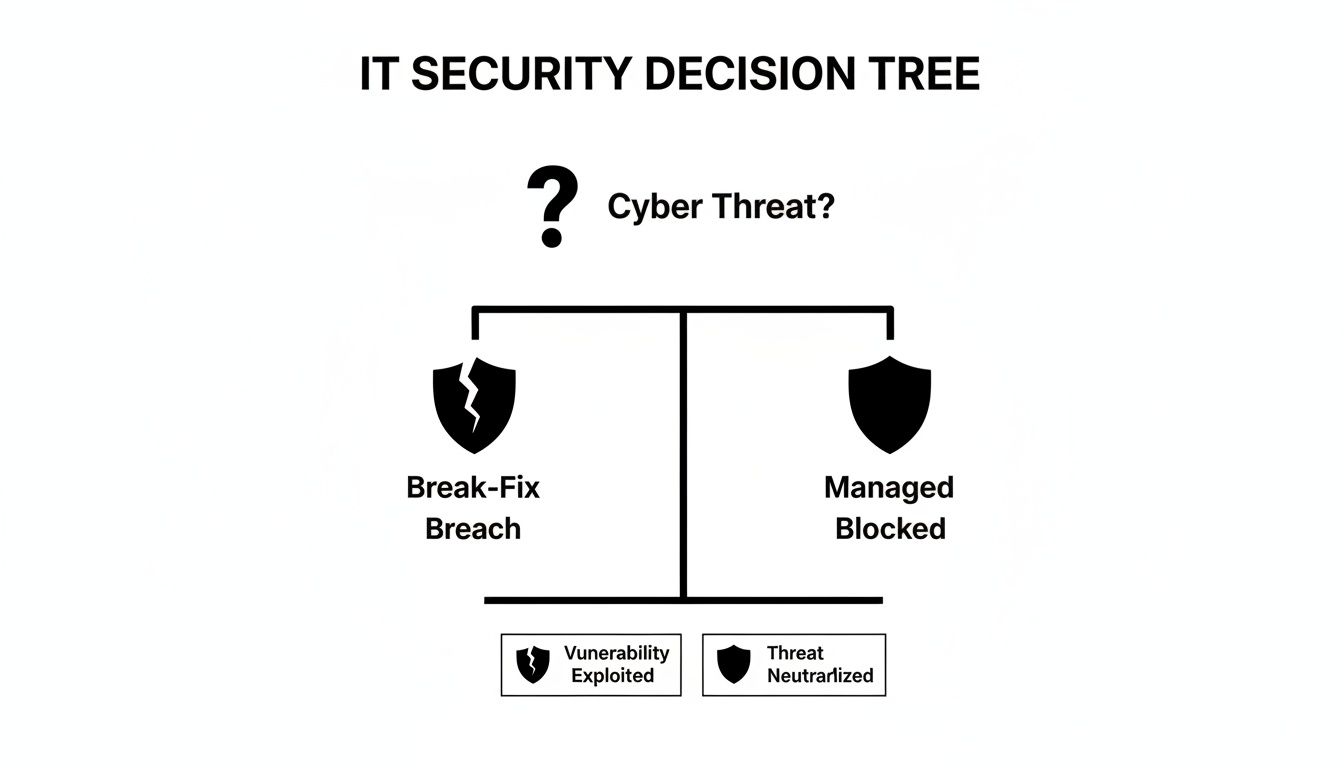
As you can see, a proactive, managed approach is designed to stop threats before they cause damage. A reactive model can only clean up the mess after a breach has already happened.
Making the Final Decision
If your answers point to expensive downtime, sensitive data, and plans for growth, the path forward becomes pretty clear.
A freelancer or a very small business with minimal tech dependency might be perfectly fine with a break/fix arrangement. But for any growing company where technology is core to operations, a managed services partner is the key to stability, security, and long-term efficiency. When thinking about which IT model is best, it's also helpful to consider the specific factors involved in choosing a Managed Service Provider, particularly if you use cloud services.
The choice isn't just about IT support; it's a strategic decision about risk management and operational resilience. Break-fix leaves you vulnerable to unpredictable events, while managed services provide a framework for consistent, secure operations.
Ultimately, investing in a proactive partnership is an investment in your business’s future. For a deeper look, check out our guide on https://www.gtcomputing.com/how-to-choose-a-managed-service-provider/ to find a partner that fits your specific needs.
Your Top Questions About IT Support Models, Answered
Choosing between managed services and the old break/fix model always sparks a few key questions. I get it. You're trying to figure out what makes the most sense for your business, not just today, but for the long haul. Let's clear up the most common questions I hear from business owners.
What's the Real Difference Here?
It all boils down to one thing: proactive versus reactive.
With managed services, we're in your corner 24/7, actively monitoring and maintaining your systems to stop problems before they start. It's about prevention, all for a flat, predictable monthly fee. The break/fix model is the complete opposite. You wait for something to break, then you call for help. This means you're only paying when you're already in trouble, which leads to surprise bills and costly downtime.
Doesn't Managed Services Cost More?
It’s easy to look at the recurring monthly fee and think it's more expensive. But when you zoom out and look at the Total Cost of Ownership (TCO), the story changes.
Break/fix might seem cheaper because you aren't paying a monthly subscription. However, the costs of emergency repairs, lost productivity while your team is dead in the water, and the potential revenue you lose during an outage can be staggering. Proactive care is designed to prevent those expensive disasters that the reactive model simply waits to react to.
The real question isn't about the monthly fee, but about the total cost of risk. A single major outage under a break-fix plan can easily cost more than an entire year of managed services.
When Should My Small Business Make the Switch?
The moment technology becomes critical to your business is the moment you should switch. Ask yourself this: if your network went down for a day, how much would it cost you?
If you handle sensitive client data, need your systems up and running to make money, or if an hour of downtime costs you more than preventing it, it’s time. For most businesses with more than a handful of employees, that time was yesterday.
Ready to Talk About a Proactive IT Strategy?
Making the right choice between a managed services partner and a break/fix shop is a major decision, one that directly impacts your company's stability and ability to grow. It’s about more than just fixing computers; it's about shifting from reacting to IT disasters to building real operational resilience.
If you’re tired of the costly emergencies and unpredictable bills that come with reactive support, maybe it’s time for a different approach. We're here to be your strategic partner, making sure your technology is a reliable asset that drives your business forward, not a constant source of frustration.
Let’s Keep Your Business Running, Without the Headaches.
GT Computing offers fast, dependable support for businesses and residential clients alike. From network setup and data recovery to a fully managed IT plan, our goal is to keep you secure, productive, and focused on what you do best.
Ready for a conversation?
Get in touch for a free, no-obligation consultation.
Call: 203-804-3053
Email: Dave@gtcomputing.com
Keep your business running without IT headaches.
GT Computing provides fast, reliable support for both residential and business clients. Whether you need network setup, data recovery, or managed IT services, we help you stay secure and productive.
Contact us today for a free consultation.
Call 203-804-3053 or email Dave@gtcomputing.com