


Think of your standard cybersecurity tools—like firewalls and antivirus software—as the locks on your doors and windows. They're essential for keeping known threats out. But what happens when a sophisticated intruder picks the lock or slips through an open window? That’s where Managed Detection and Response (MDR) comes in.
MDR isn't just another alarm system. It's your on-demand, 24/7 security team actively patrolling inside your network, hunting for threats that have already bypassed your first line of defense.
Your Proactive Cybersecurity Partner

If your cybersecurity strategy feels like waiting for a smoke detector to go off, you're living in a reactive world. You’re waiting for the fire to start before you do anything. MDR flips that script completely. It’s the team of firefighters already on-site, looking for sparks and signs of trouble before they can erupt into a full-blown inferno.
So, how does it work? It starts with powerful technology monitoring everything on your network: from employee laptops and servers to cloud applications. But here's the crucial part: instead of bombarding you with thousands of meaningless alerts, the system uses AI to filter the noise and pinpoint genuinely suspicious activity.
Beyond Automated Alerts
This is where the real value of MDR shines. Once a credible threat is flagged, it doesn't just go into a queue. It goes directly to a team of human security analysts.
These experts have the experience to tell the difference between a developer running a weird-but-legitimate script and an attacker making their first move. An automated tool sees an anomaly; a human expert sees intent.
MDR fundamentally changes your security posture from a reactive, alert-fatigued model to a proactive, threat-hunting operation. It’s the difference between waiting to get hit and actively looking for who might be throwing the punches.
This level of service is a game-changer, especially for businesses that can't afford to build their own 24/7 security operations center (SOC). Think about it:
- Law firms are a prime target, with attackers desperate to get their hands on confidential case files.
- Dental practices hold a treasure trove of protected health information (PHI) that is extremely valuable on the dark web.
- Financial advisors manage sensitive client investment data, where a breach could lead to financial ruin and a total loss of trust.
For these businesses, a data breach isn’t just an IT headache. It can be a catastrophic, business-ending event. MDR delivers the kind of enterprise-grade protection that was once only available to large corporations. You can get a more technical perspective on Managed Detection and Response in this detailed guide.
Ultimately, it’s about having experts watch your back so you can focus on running your business. That's why MDR is such a critical part of any modern strategy for managed IT services for small business.
How MDR Protects Your Business Step-by-Step
So, what does Managed Detection and Response (MDR) actually do? Let's pull back the curtain and look at the play-by-play. It’s less like a simple alarm system and more like having a dedicated team of digital detectives on your payroll, working around the clock.
This isn’t a passive service that just waits for something to break. It’s an active, continuous cycle of finding threats, neutralizing them, and then using that knowledge to make your defenses even stronger for the next time.
Proactive Threat Hunting
It all starts with something called proactive threat hunting. Instead of just reacting to alerts, MDR analysts are actively combing through your network looking for trouble. Armed with sophisticated AI, they hunt for the subtle clues that automated tools often miss—things like a user account logging in at 3 a.m., unusual data transfers, or a piece of software trying to connect to a suspicious server.
Think of it this way: a basic security system alerts you when a window is broken. An MDR team is like a security guard actively patrolling the grounds, noticing someone lurking in the shadows, and investigating before they can even get close to the building. This constant watchfulness is key to stopping sophisticated attacks in their tracks. To get a better sense of how this continuous oversight is achieved, you can learn more about what is network monitoring.
Triage and Prioritization
Next up is the crucial step of triage and prioritization. Any busy network generates a constant stream of alerts, and honestly, most of them are just noise. This "alert fatigue" can easily overwhelm an in-house IT team, causing them to miss the one critical alert that actually matters.
An MDR service cuts through that noise. Experienced analysts quickly evaluate every alert, separating the genuine threats from the false alarms. They use context to decide what needs immediate action and what can be ignored. This frees up your team’s time and ensures that all hands are focused on real, verified threats.
The superpower of MDR is this combination of human expertise and machine speed. An automated system can flag an anomaly in milliseconds, but it takes a seasoned analyst to understand the context, intent, and potential business impact of that anomaly.
This methodical sorting process brings order to the potential chaos. Instead of a fire drill for every minor alert, genuine threats are identified and handled with precision and calm.
Investigation and Guided Response
Once a real threat is confirmed, the threat investigation kicks into high gear. MDR experts become digital forensics investigators, digging deep to figure out exactly what happened. They work to answer the critical questions:
- How did the attacker get in?
- What parts of our network are affected?
- Are they stealing data or trying to encrypt our files?
- What is their end game?
After the investigation, you get a guided response—not a dense technical report, but a clear, step-by-step action plan. The MDR team tells you exactly what to do to contain the threat, kick the intruder out, and restore your systems. This speed is everything. In fact, studies show MDR services deliver an average response time of just three hours, while in-house teams often take around 66 hours. You can read more about the impact of response times on Integrity360.com. Acting that quickly can be the difference between a minor incident and a major business disruption.
MDR vs. MSSP vs. EDR: Understanding the Differences
The world of cybersecurity is swimming in acronyms, and it's easy to get lost. When you're trying to figure out the best way to protect your business, you'll likely run into three big ones: MDR, MSSP, and EDR. They might sound similar, but they play very different roles in keeping you safe.
Let's break down what each one does—and more importantly, what they don't do—so you can see exactly where Managed Detection and Response (MDR) fits in.
MDR vs MSSP vs EDR A Quick Comparison
To get a clear picture, it helps to see these services side-by-side. Each one tackles security from a different angle, offering distinct levels of engagement and protection. This table lays out the core differences in what they do, where they focus, and who they're best for.
| Feature | MDR (Managed Detection and Response) | MSSP (Managed Security Service Provider) | EDR (Endpoint Detection and Response) |
|---|---|---|---|
| Core Function | Proactive threat hunting, investigation, and guided response. | Management and monitoring of existing security devices (e.g., firewalls). | A software tool that provides threat visibility and automated blocking on endpoints. |
| Primary Focus | Detecting and neutralizing advanced, active threats that bypass traditional defenses. | Perimeter security, log management, and compliance reporting. | Device-level (endpoint) security and data collection. |
| Typical Use Case | Businesses needing 24/7 expert monitoring and active threat response without an in-house security team. | Organizations needing to manage security infrastructure and meet compliance requirements. | Companies with a dedicated security team that needs deep visibility into endpoint activity. |
As you can see, the main difference comes down to being proactive versus reactive. While MSSPs and EDR are important pieces of the puzzle, MDR is designed to actively hunt down and stop threats in their tracks.
MSSP: The Traditional Security Guard
A Managed Security Service Provider (MSSP) is the oldest model of the three. Think of them as a security company that monitors your existing alarm system from afar. Their job is to manage your security tools—like firewalls and intrusion prevention systems—and let you know if an alarm goes off.
They're primarily focused on managing the perimeter and keeping an eye on security logs. This often involves:
- Managing and patching firewalls.
- Monitoring alerts from various security tools.
- Generating reports needed for compliance audits.
The problem is, MSSPs often just pass the alerts along to you. They'll tell you a sensor was tripped, but it’s still your responsibility to figure out if it was a real burglar or just the cat. This can create a ton of noise and leave your team chasing down false positives. This approach often relies heavily on tools like Security Incident and Event Management (SIEM) systems to collect all that log data.
EDR: The Advanced Security Camera
So where does Endpoint Detection and Response (EDR) fit in? An EDR solution isn't a service; it's a powerful tool. Imagine installing high-definition, AI-powered cameras on every computer, laptop, and server in your company.
These tools provide incredible visibility. They record everything happening on your devices (the "endpoints") and can even automatically take action, like quarantining a machine if it detects a known virus. But here’s the catch: someone still needs to watch the footage. An EDR platform generates a massive amount of data, and you need a team of experts to interpret it, investigate subtle anomalies, and respond to threats that aren't so clear-cut.
EDR gives you the critical visibility, but MDR provides the human expertise to turn that visibility into a decisive response. Owning the best security camera system in the world doesn't help much if no one is watching the monitors.
For most businesses, buying an EDR tool without the dedicated 24/7 staff to run it is a recipe for disaster. It creates a false sense of security.
MDR: The Elite Response Team
This is where Managed Detection and Response (MDR) changes the game. If an MSSP is the distant guard and EDR is the camera, MDR is the elite, boots-on-the-ground security team that actively patrols your environment, investigates every suspicious event, and neutralizes threats before they can do real damage.
MDR services combine the powerful technology of an EDR tool with a dedicated, 24/7 team of security analysts. They don't just send you alerts—they take ownership of the entire process.
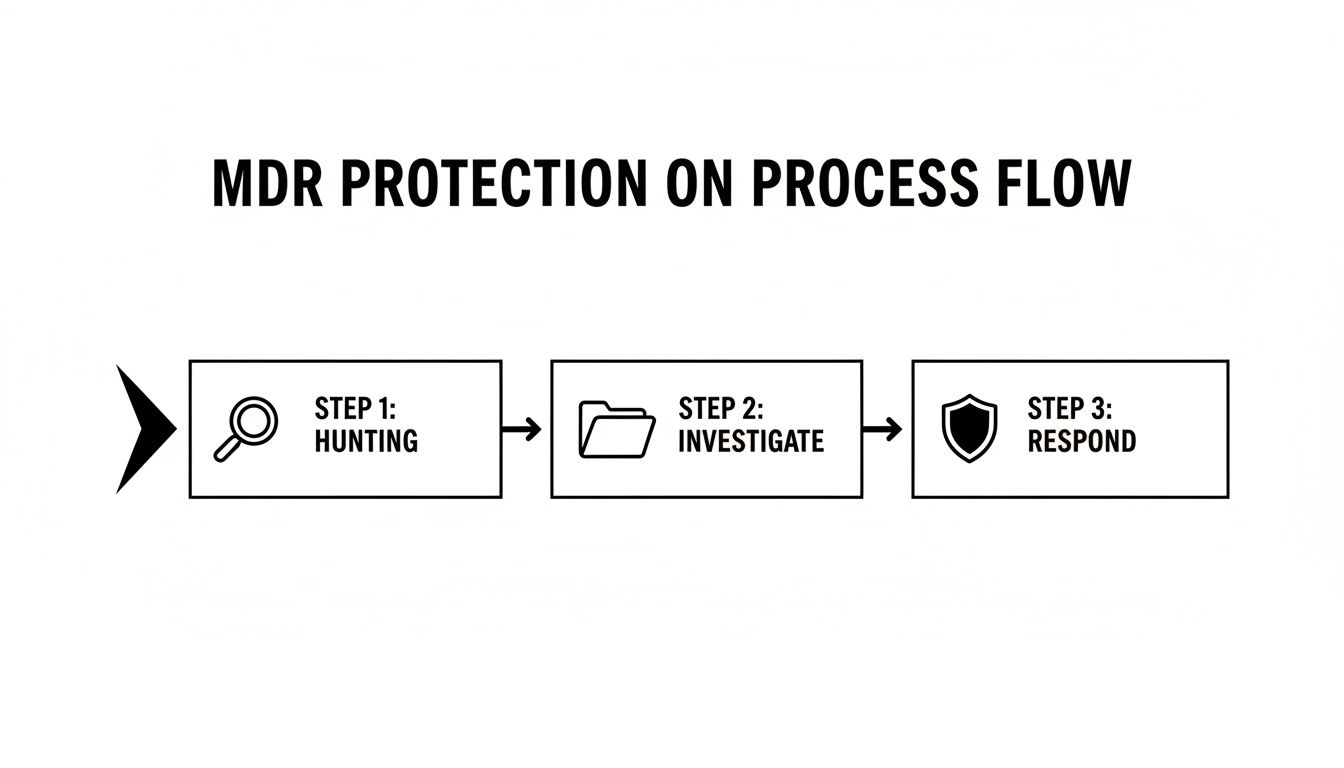
This constant cycle of hunting, investigating, and responding is what sets MDR apart. It’s an active, hands-on service focused on security outcomes, not just alerts. This focus on proactive management over reactive fixes is a core principle in IT, and you can see similar logic when comparing managed services vs break-fix support models.
Ultimately, MDR delivers the people, processes, and technology needed for true threat defense, making it the most practical and effective solution for businesses that can't afford to build their own security operations center.
What Are the Real-World Benefits of MDR?
It’s easy to get lost in the technical jargon, but what does Managed Detection and Response actually mean for your business? The value isn't found in a list of software features; it's in the real, tangible outcomes that protect your operations, your reputation, and your bottom line.
Think of it this way: MDR is less about buying a better burglar alarm and more about hiring a 24/7 security team that lives on-site. Here’s what that looks like in practice.

Get Instant Access to Elite Cybersecurity Talent
Let's be blunt: hiring a team of cybersecurity experts is a huge challenge. Top analysts command six-figure salaries, and you'd need several of them to provide true 24/7 coverage. For most small and mid-sized businesses, building a dedicated, in-house Security Operations Center (SOC) is simply out of reach financially.
MDR completely changes the math. You get immediate access to a whole team of seasoned security professionals for a predictable monthly cost. It’s like having a squad of world-class digital detectives on call, but for a fraction of what it would cost to hire even one of them. This is how smaller businesses can get the same level of defense as a major corporation.
Put an End to "Alert Fatigue"
Modern security tools are incredibly chatty. They can generate thousands of alerts every single day, and the overwhelming majority are false positives or minor events. This endless noise leads to "alert fatigue," a dangerous state where your IT team is so swamped they can't see the real threats hiding in plain sight.
MDR acts as your expert filter. The provider's analysts sift through every single alert, using their experience and advanced tools to separate the harmless noise from the genuine threats. They only escalate the verified, critical issues that truly need your attention.
This frees your team from chasing digital ghosts and lets them focus on what they do best—driving your business forward. Security goes from being a constant distraction to a quiet, effective shield.
Respond to Threats in Minutes, Not Days
When a cyberattack hits, the clock is your enemy. Every second an attacker remains in your network, the damage they can cause—and the cost to fix it—grows exponentially. A slow response can turn a minor issue into a company-ending disaster.
MDR is built for speed.
- Scenario: Ransomware starts encrypting files at a small dental practice at 2 AM on a Saturday.
- Without MDR: The attack runs wild all weekend. By Monday morning, every patient record, appointment schedule, and billing system is encrypted. The practice is paralyzed, facing weeks of downtime, huge recovery costs, and a loss of patient trust.
- With MDR: Within minutes of the first file being encrypted, the MDR team's system detects the suspicious activity. An analyst immediately investigates, confirms the attack, and isolates the infected computer from the network, stopping the ransomware in its tracks. The impact is limited to one machine, and the practice is ready for patients on Monday.
This rapid containment is the core of MDR's value, turning potential catastrophes into manageable incidents.
Simplify Your Regulatory Compliance
If you're in an industry like healthcare, finance, or law, protecting client data isn't optional—it's the law. Regulations like HIPAA demand rigorous, continuous monitoring of sensitive information, and the penalties for failing to comply are severe.
An MDR service gives you the 24/7 monitoring and detailed event logs you need to help satisfy these demanding requirements. It provides concrete proof that you're taking professional, proactive steps to guard your data. This not only helps you pass audits and avoid fines but also builds invaluable trust with the clients who depend on you.
Ultimately, MDR helps you shift from a reactive security stance to a proactive one. Instead of just reacting to breaches after they happen, you have a dedicated team actively hunting for threats and neutralizing them before they can do any harm. It's the difference between cleaning up a flood and having a system that stops the pipes from ever bursting.
Keep your business running without IT headaches.
GT Computing provides fast, reliable support for both residential and business clients. Whether you need network setup, data recovery, or managed IT services, we help you stay secure and productive.
Contact us today for a free consultation.
Call 203-804-3053 or email Dave@gtcomputing.com
Why You Cannot Afford to Ignore MDR in 2026
Let's be blunt: in 2026, relying on just a firewall and antivirus software to protect your business is like bringing a pocketknife to a gunfight. The threats have evolved. We're now up against things like fileless malware that hides in your system's memory and zero-day exploits that target vulnerabilities nobody even knows about yet. Your old security playbook just doesn't apply anymore.
For a small or mid-sized business, this is a terrifying reality. You don't have the infinite resources of a global corporation, but you face the same ruthless attackers. A single breach can be devastating, leading to massive financial hits, operational chaos, and a loss of customer trust that you've spent years building. The rise of remote work and cloud platforms has only opened up more doors for attackers to walk through.
The Threat Landscape is Exploding
The numbers don't lie. We're not just seeing a small uptick in cyber threats; we're witnessing an exponential surge. This isn't just a big-city problem—it’s happening everywhere, and it's forcing a massive shift in how businesses defend themselves.
The global market for Managed Detection and Response was valued at USD 3.50 billion in 2023 and is projected to hit a staggering USD 15.31 billion by 2030. That kind of growth only happens when there's an urgent, undeniable need.
This isn't just about enterprise-level companies, either. Analysts are predicting that by 2025, 50% of all organizations will use MDR for their threat monitoring and response. You can dig into the market projections yourself over at Grand View Research. The data makes it clear: waiting for an attack is no longer a viable strategy.
It's Time to Flip the Script on Defense
Most traditional security puts you on the back foot. You're stuck in a reactive loop, waiting for an alarm to go off before you can scramble to clean up the damage. This "wait-and-see" approach is a guaranteed losing game against today's hyper-aggressive and automated attacks.
This is where Managed Detection and Response completely changes the game. It moves you from a passive, reactive posture to an active, "hunt-and-neutralize" mindset. Instead of just waiting for the alarm, an MDR team is actively hunting for threats that have already slipped past your first line of defense.
Here's what that looks like in the real world:
- Catching Intruders Early: Spotting attackers the moment they get in, long before they can encrypt your files or steal sensitive data.
- Human Expertise on Call: Having real security experts analyze every alert. They can instantly tell a genuine threat from a false positive, so you're not chasing ghosts.
- Stopping the Bleeding, Fast: Quickly isolating a compromised laptop or server to prevent an attack from spreading across your entire network.
Think of it this way: MDR is your 24/7 security team on patrol. In a world where a breach can unfold in minutes, having a team that responds in seconds isn't a luxury—it's essential for survival. An investment in MDR is an investment in making your business a much, much harder target.
Keep your business running without IT headaches.
GT Computing provides fast, reliable support for both residential and business clients. Whether you need network setup, data recovery, or managed IT services, we help you stay secure and productive.
Contact us today for a free consultation.
Call 203-804-3053 or email Dave@gtcomputing.com
How We Deliver Powerful MDR Services
Knowing what Managed Detection and Response is is one thing. Having it implemented by a team you trust to protect your business is another thing entirely. At GT Computing, we don't just sell you a security product and walk away. We make powerful MDR a core part of a complete IT strategy, built from the ground up for businesses right here in Connecticut.
Our approach works so well because we start with a deep understanding of your entire technology setup. That gives us a massive advantage when it comes to keeping you safe.
We See the Whole Picture
Most security-only vendors are looking at your business through a keyhole. We see the whole room. Because we're also your day-to-day managed IT provider, we have an intimate, working knowledge of your infrastructure—from the custom Ubiquiti or Meraki networks we build to your VoIP phone systems and data backup routines.
This complete picture allows us to manage your MDR with a level of precision others can't match. We already know how your team works, what data is most critical to your operations, and how your employees use their tools every day. That context is priceless when it comes to spotting a real threat.
Instead of treating security as a separate service you bolt onto your operations, we weave it directly into the fabric of your IT. This ensures your defenses are always working with your business goals, not against them.
Think of it this way: a standalone security provider might flag a large data transfer as a potential breach. We’d know it’s just your scheduled nightly backup. On the flip side, we can spot subtle changes in user behavior that look normal on the surface but are actually the first sign of an intrusion, because we know what "normal" truly looks like for you.
Your Single, Trusted IT Partner
When you work with GT Computing for MDR, you get rid of the complexity and blame games that come with juggling multiple vendors. You get the peace of mind that comes from having a single, local team managing both your daily IT support and your advanced cybersecurity.
Having one trusted partner for everything gives you a few key advantages:
- No Finger-Pointing: If an issue pops up, there's no back-and-forth about whose job it is to fix it. We own the problem from the moment it's detected until it's fully resolved.
- Faster Response: Our familiarity with your network means we can investigate and shut down threats much faster. This drastically minimizes potential damage and costly downtime.
- An Aligned Strategy: Your security posture is always in lockstep with your business needs. We make sure our protective measures never get in the way of your team's productivity.
Ultimately, our goal is to give you a security solution that works so smoothly in the background, you can forget it's there and focus on what you do best—running your business. By combining our hands-on managed IT expertise with top-tier MDR technology, we deliver enterprise-grade security with the personal service of a local partner who actually knows your name.
Keep your business running without IT headaches.
GT Computing provides fast, reliable support for both residential and business clients. Whether you need network setup, data recovery, or managed IT services, we help you stay secure and productive.
Contact us today for a free consultation.
Call 203-804-3053 or email Dave@gtcomputing.com
Frequently Asked Questions About MDR
It's only natural to have questions when you're looking at a service as critical as Managed Detection and Response. You need straightforward answers to figure out if it's the right fit. Here are a few of the most common questions we hear from business owners.
Is MDR Affordable for a Small Business?
Absolutely. In fact, you could argue that small and mid-sized businesses get the most value out of MDR. It’s built to deliver top-tier security without the astronomical price tag.
Think about it: hiring even one full-time cybersecurity expert would cost a fortune, and you'd still only have coverage during business hours. MDR gives you an entire 24/7 team of specialists and their advanced toolset for a predictable, flat monthly fee. When you weigh that against the catastrophic cost of a data breach, MDR isn't just an expense—it's one of the smartest investments you can make in your company's future.
Does MDR Replace My Current Antivirus or Firewall?
Not at all. MDR actually makes them better. Think of your firewall and antivirus software as the locks on your front door and windows. They’re essential for stopping the common, everyday threats trying to get in, and you absolutely still need them.
MDR is the expert security team patrolling inside the building. It’s designed to hunt for the sophisticated threats that are smart enough to pick the locks or find an unlocked window. These are the stealthy attacks that traditional tools often miss.
MDR doesn't replace your foundational security; it completes it. It adds the human expertise and active threat hunting needed to stop attacks that automated tools alone will miss.
This layered security model means you’re protected against both the high-volume, automated attacks and the more dangerous, targeted ones.
How Long Does It Take to Implement MDR?
The onboarding process is surprisingly quick and designed to cause almost zero disruption. A huge benefit of any good MDR service is that the provider's professional team handles the entire technical setup for you.
We integrate the service with your existing IT systems, deploy the necessary monitoring software, and get everything connected to our 24/7 security operations center. Most businesses are fully up and running in a very short amount of time. The moment it’s activated, the system starts watching your back.
My Business Is Small. Are We Really a Target?
Yes, and this is probably the most dangerous misconception out there. Cybercriminals specifically target small businesses because they assume your defenses are weaker. They see you as a soft, high-value target.
Attackers know that a small accounting firm, medical practice, or local manufacturer holds incredibly sensitive data but likely can't afford a dedicated security department. For a small business, a single ransomware incident can be a company-ending event. MDR evens the odds, giving you the kind of powerful, always-on protection that was once only available to massive corporations.
Keep your business running without IT headaches.
GT Computing provides fast, reliable support for both residential and business clients. Whether you need network setup, data recovery, or managed IT services, we help you stay secure and productive.
Contact us today for a free consultation.
Call 203-804-3053 or email Dave@gtcomputing.com